Setting up a pickleball court in a gym: a checklist for municipalities
Published on 29 October 2026 Last updated 29 October 2026 4 min read
Signed: the Poteaux Pliants editorial team.
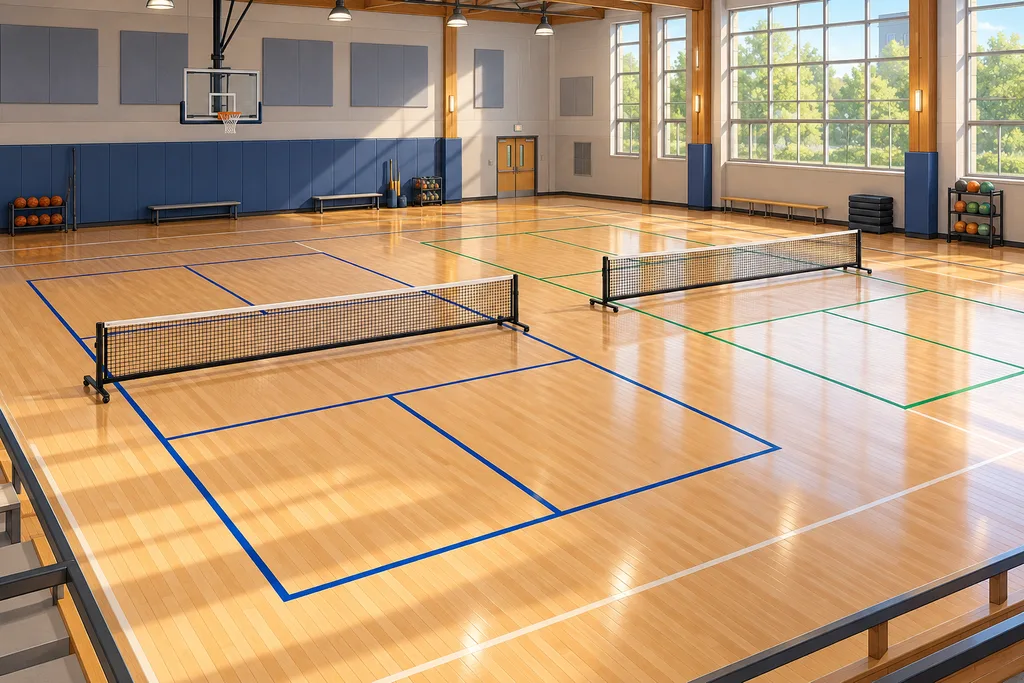
Microphone open on “Setting up a pickleball court in a gym: a checklist for municipalities,” with time to unroll everything properly. The aim is to prepare a gym to host several temporary courts. The tour sweeps from top to bottom through the use cases, the decision factors in plain terms and the how-to up close. The text is written for beginner or regular players, parents, club organizers and managers of halls or local governments who want to set up a temporary pickleball court.
The FFT has obtained the delegation for pickleball from the Ministry of Sports, which allows it to speed up the development of the sport across the country. Pickleball is played indoors as well as outdoors, with balls of slightly different design depending on the type of surface. The Fédération française de tennis states that up to four pickleball courts can fit on a single tennis court, which makes it possible to reuse existing equipment.
The use cases
Basic point to grasp: the non-volley zone line is parallel to the net and sits 7 feet (2.13 m) from it. The center line runs from that line to the baseline and separates the even and odd service areas. To be read alongside the neighboring sections.
Foundation of the subject: the recommended minimum playing area is 30 feet by 60 feet (9.14 m by 18.29 m). For new construction or a tournament, the rulebook recommends 34 feet by 64 feet, which leaves room around the court. To be read alongside the neighboring sections.
The decision factors in plain terms
The elements of judgment follow below this sentence.
- A pickleball court is a rectangle 20 feet wide by 44 feet long, or 6.10 m by 13.41 m. These dimensions are the same for singles and doubles.
- Pickleball requires a hard surface and is not suited to a clay court. Any tennis court other than clay, or a sports hall, can host the game.
- The FFT offers affiliated clubs financial support, through its club and participation development program, to create permanent pickleball courts.
The how-to up close
A sequence to follow step by step, without skipping a line.
- To mark out a temporary court, chalk, line-marking paint, adhesive tape or masking tape can be used, as long as the color contrasts well with the floor.
- For a temporary court, hard surfaces such as concrete or asphalt are considered optimal, and a gym floor works just as well.
- For an improvised court, about 7 feet (2.1 m) is recommended between the baseline and a wall or other barrier, to leave room for movement and safety.
The pitfalls
A discreet hazard: on grass or uneven ground, the effective net height can vary slightly along the baseline; this is why hard courts are the official standard in competition. Worth marking with a cross in the margin.
How much space to plan per court?
An example from real life: the Pickleball Time club in Nîmes, billed as the first club in the South entirely dedicated to pickleball, has 5 indoor courts and 2 outdoor courts. Each court measures 9 m by 18 m and the ceiling height reaches 6.5 m.
Wrapping up
On the chronicle's tally: the use cases, the decision factors in plain terms, the how-to up close and the pitfalls. End of the chronicle: the useful passages are worth rereading at leisure.
You may also like
- Setting up a temporary pickleball court: tennis, gym or yard — Pickleball courts on tennis courts, in gyms or at home. Sections covered: the essentials without detours and every article in the category.
- Non-volley zone: marking it correctly and explaining the rule — How to mark the non-volley zone and explain why volleying is not allowed inside it. On the program: the mechanics in detail and the opening moves.
- Marking out a pickleball court on a tennis court — Adapting a tennis court with temporary markings and a portable net. Sections on the program: the context up close and the steps in plain terms.
- The FFT and pickleball: delegation, license and organization — What the FFT delegation changes for clubs and players, followed by the starting findings: the essentials, section by section in this chronicle.
Reference material
- Assemblée générale de la FFT, les décisions — Ministerial delegation, Club FFT license of September 2026 (€33 adults, €23 ages 7-18), development plan and approximate numbers of players and license holders. Source accessed 2026-10-18.
- What Is Pickleball? Rules, History & How to Play — Court of 20 x 44 feet, net at 36 inches at the posts and 34 inches at the center, 7-foot non-volley zone. Source accessed 2026-10-18.
- L'accompagnement de la FFT dans l'essor du pickleball — FFT news item: setup on tennis courts and financial support for clubs. Source accessed 2026-10-30.
- 2025 USA Pickleball Rules Section 2: Court and Equipment —
- Le pickleball, encore un nouveau sport de raquettes — Belgian press article (2022) on the installation of pickleball in Arlon. Source accessed 2026-10-30.
- How to Make a Pickleball Court (makeshift court guide) — Editorial guide to makeshift courts: space, surface, marking materials. Source accessed 2026-10-30.
- Pickleball net height: official measurements explained — Heights of 34 and 36 inches, width of 22 feet, role of the center strap in sanctioned play. Source accessed 2026-10-18.
- Nîmes : le premier club du Sud entièrement dédié au pickleball ouvrira fin mars — Integration of pickleball into the FFT on January 1, 2026 and an example of a dedicated club opening. Source accessed 2026-10-18.
The dimensions cited rely on USA Pickleball rules; for a competition in France, the specifications currently in force should be checked with the FFT or the relevant league.
The product tests cited may contain affiliate links: this site sells no equipment.