Non-volley zone: marking it correctly and explaining the rule
Published on 29 October 2026 Last updated 29 October 2026 4 min read
Signed: the Poteaux Pliants editorial team.
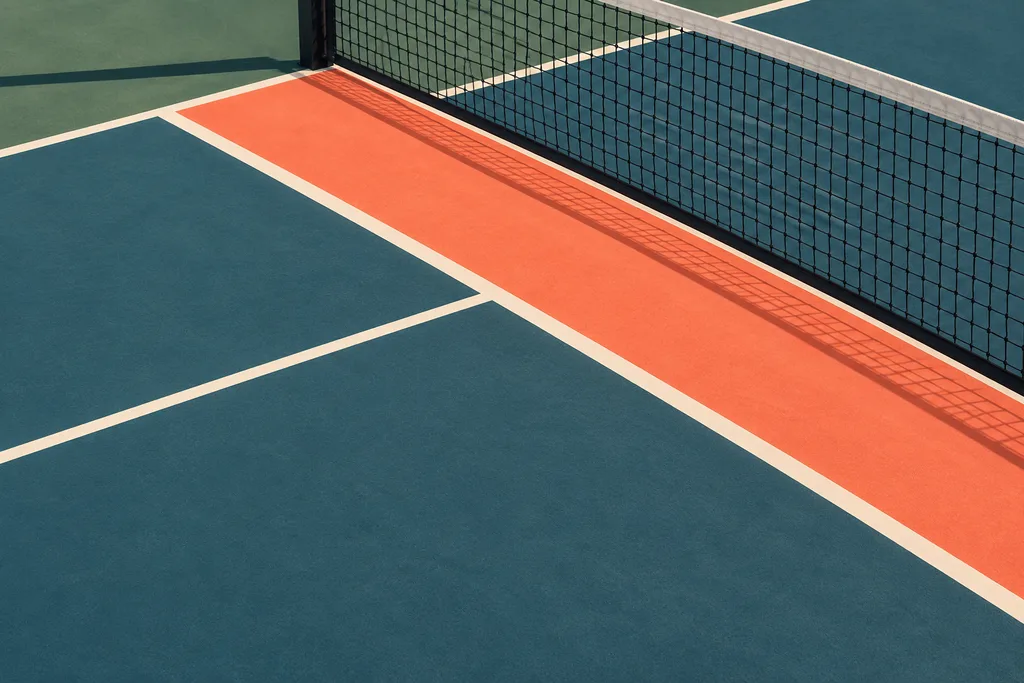
Heading for “Non-volley zone: marking it correctly and explaining the rule,” with no wrong note and no needless detour. The aim is to mark the non-volley zone and explain why volleying is not allowed inside it. On the chronicle's agenda: the mechanics in detail, the opening moves and the pitfalls. The text is written for beginner or regular players, parents, club organizers and managers of halls or local governments who want to set up a temporary pickleball court.
Pickleball was officially integrated into the Fédération Française de Tennis (FFT) on January 1, 2026, according to the regional press. Starting September 1, 2026, pickleball moves from its specific license to the new “Club FFT license.” There is no longer a separate license, and players can alternate between racket sports over the course of the season. The FFT general assembly reports nearly 30,000 pickleball players in France for 3,500 licenses, with about 50% of players being women.
The mechanics in detail
Rule at the core: a pickleball court is a rectangle 20 feet wide by 44 feet long, or 6.10 m by 13.41 m. These dimensions are the same for singles and doubles.
What serves as the foundation: the FFT offers affiliated clubs financial support, through its club and participation development program, to create permanent pickleball courts.
Rule at the core: the non-volley zone line is parallel to the net and sits 7 feet (2.13 m) from it. The center line runs from that line to the baseline and separates the even and odd service areas. To be read alongside the neighboring sections.
As a cornerstone, pickleball requires a hard surface and is not suited to a clay court. Any tennis court other than clay, or a sports hall, can host the game.
The opening moves
A sequence to follow step by step, without skipping a line.
- For an improvised court, about 7 feet (2.1 m) is recommended between the baseline and a wall or other barrier, to leave room for movement and safety.
- To mark out a temporary court, chalk, line-marking paint, adhesive tape or masking tape can be used, as long as the color contrasts well with the floor.
- For a temporary court, hard surfaces such as concrete or asphalt are considered optimal, and a gym floor works just as well.
The pitfalls
A pitfall to avoid: on grass or uneven ground, the effective net height can vary slightly along the baseline; this is why hard courts are the official standard in competition.
How deep should the zone be?
A scene to imagine: pickleball was born in 1965 on Bainbridge Island, in Washington State. Three fathers, Joel Pritchard, Bill Bell and Barney McCallum, invented the game with table tennis paddles, a Wiffle ball and a lowered badminton net.
A development worth noting: the FFT has obtained the delegation from the Ministry of Sports for pickleball. It is rolling out an acceleration plan: support for clubs (court funding, equipment kits), digital tools for accessing competitions, a high-level pathway and official French championships.
In concrete terms, the Rally catalog includes a pickleball paddle model, to give an idea.
Wrapping up
As a reminder, the chronicle has gone through the mechanics in detail, the opening moves and the pitfalls. This page is worth keeping close at hand to come back to when needed.
You may also like
- Setting up a temporary pickleball court: tennis, gym or yard — Pickleball courts on tennis courts, in gyms or at home. Sections covered: the essentials without detours and every article in the category.
- Setting up a pickleball court in a gym: a checklist for municipalities — Preparing a gym to host several temporary pickleball courts. Section by section: the use cases and the decision factors, explained in plain terms.
- Marking out a pickleball court on a tennis court — Adapting a tennis court with temporary markings and a portable net. Sections on the program: the context up close and the steps in plain terms.
- The FFT and pickleball: delegation, license and organization — What the FFT delegation changes for clubs and players, followed by the starting findings: the essentials, section by section in this chronicle.
Reference material
- Nîmes : le premier club du Sud entièrement dédié au pickleball ouvrira fin mars — Integration of pickleball into the FFT on January 1, 2026 and an example of a dedicated club opening. Source accessed 2026-10-18.
- Assemblée générale de la FFT, les décisions — Ministerial delegation, Club FFT license of September 2026 (€33 adults, €23 ages 7-18), development plan and approximate numbers of players and license holders. Source accessed 2026-10-18.
- What Is Pickleball? Rules, History & How to Play — Court of 20 x 44 feet, net at 36 inches at the posts and 34 inches at the center, 7-foot non-volley zone. Source accessed 2026-10-18.
- L'accompagnement de la FFT dans l'essor du pickleball — FFT news item: setup on tennis courts and financial support for clubs. Source accessed 2026-10-30.
- 2025 USA Pickleball Rules Section 2: Court and Equipment —
- Le pickleball, encore un nouveau sport de raquettes — Belgian press article (2022) on the installation of pickleball in Arlon. Source accessed 2026-10-30.
- How to Make a Pickleball Court (makeshift court guide) — Editorial guide to makeshift courts: space, surface, marking materials. Source accessed 2026-10-30.
- Pickleball net height: official measurements explained — Heights of 34 and 36 inches, width of 22 feet, role of the center strap in sanctioned play. Source accessed 2026-10-18.
The dimensions cited rely on USA Pickleball rules; for a competition in France, the specifications currently in force should be checked with the FFT or the relevant league.
The product tests cited may contain affiliate links: this site sells no equipment.